
Somewhere between 3,000 and 6,000 meters below the ocean's surface, in complete darkness and under crushing pressure, lives a group of copepods most people have never heard of, let alone seen. Abyssal copepods occupy one of the most extreme environments on the planet, and the more scientists learn about them through deep-sea exploration, the more they reveal about how life adapts to conditions that would be instantly lethal almost anywhere else.
These are genuinely different animals from the copepods most reef keepers are familiar with. While the harpacticoid and cyclopoid copepods commonly cultured for aquarium use thrive in relatively stable, temperate reef conditions, abyssal copepods have evolved an entirely different set of survival tools built around darkness, cold, and pressure that would crush most surface-dwelling organisms.
Despite their tiny size, often under two millimeters, abyssal copepods carry a remarkable set of physical adaptations. Their exoskeletons are built with flexibility that resists crushing under pressures that would shatter more rigid structures. Their metabolism runs on an intentionally slow rhythm, tuned to the nutrient scarcity of the deep ocean rather than the relatively food-rich conditions found in shallower water. Some species have developed bioluminescent capabilities, using light produced within their own bodies to communicate, evade predators, or attract prey in an environment where sunlight never reaches.
| Trait | Abyssal Copepods | Reef Aquarium Copepods |
|---|---|---|
| Habitat depth | 3,000 to 6,000 meters | Shallow reef, rockwork, substrate |
| Metabolism | Slow, tuned to nutrient scarcity | Fast, supports rapid reproduction |
| Primary food source | Marine snow, sinking organic particles | Phytoplankton, detritus, biofilm |
| Home aquarium suitability | Not viable, extreme habitat needs | Well suited, widely cultured |
Ecologically, abyssal copepods play a genuinely important role in the deep sea, one that extends well beyond simply surviving in a hostile environment. They feed primarily on marine snow, the constant, gentle rain of organic particles sinking down from the productive waters far above. By consuming and processing this material, they help break down and redistribute nutrients throughout the abyssal zone, supporting an entire food web of deep-sea fish and squid that depend on this recycling process to survive in an environment with almost no primary productivity of its own.
Advances in deep-sea exploration technology, including remotely operated vehicles and specialized submersibles, have only recently allowed scientists to observe and sample these organisms directly, and the biodiversity uncovered so far has been genuinely surprising. New abyssal copepod species continue to be discovered, each carrying its own unique set of adaptations to this extreme environment, underscoring just how much of the deep ocean remains scientifically unexplored.
Understanding why the abyssal environment demands such specialized adaptations helps explain why these copepods look and behave so differently from their shallow-water relatives. Pressure at these depths reaches levels that would crush a human body almost instantly, yet abyssal copepods move through it with exoskeletons flexible enough to withstand forces their surface-dwelling cousins never encounter. Temperature hovers barely above freezing year round, with no seasonal variation at all, forcing a metabolism that has essentially traded speed for efficiency across evolutionary time.
The complete absence of sunlight at these depths shapes abyssal copepod behavior in ways that have no real parallel in a reef tank. Without any light cues to structure daily rhythms, many deep-sea organisms, copepods included, rely on chemical signals, vibration, and in some cases bioluminescence to navigate, find food, and avoid predators. This sensory world is genuinely alien compared to the light-driven, visually oriented behavior most aquarium copepods display in a well-lit reef tank.
Researchers studying abyssal copepods face genuine logistical challenges that most marine biology does not encounter. Bringing a live abyssal copepod up to the surface exposes it to a pressure change severe enough to be fatal, which means much of what scientists know comes from in-situ observation using submersibles and remotely operated vehicles, or from careful sampling techniques designed to minimize pressure shock. This is part of why abyssal copepod research has accelerated only recently, as deep-sea exploration technology has finally caught up to the scientific curiosity surrounding these organisms.
Given all of this, it is worth being direct about something important: abyssal copepods are not, and realistically cannot be, kept in a home aquarium. Their entire biology is built around conditions, extreme pressure, near-freezing temperatures, and total darkness, that no home tank can replicate or would want to. Their appeal to hobbyists is genuinely educational and inspirational rather than practical, a reminder of just how far copepods as a group have adapted across the full range of ocean environments.
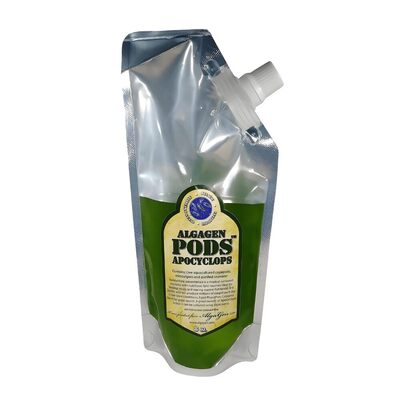
That appreciation, though, often translates directly into a deeper interest in the copepod species reefers actually can keep and benefit from. AlgaGenPods™ Apocyclops represents that accessible, practical side of the copepod world, a species built for exactly the stable, temperate reef conditions that a home aquarium can realistically provide. Where abyssal copepods survive on scarcity and darkness, Apocyclops thrives on consistent phytoplankton feeding and the relatively abundant conditions of a well-maintained reef tank.
The contrast between abyssal and reef-dwelling copepods actually highlights something worth appreciating about the copepod group as a whole. Few organisms occupy such a broad range of environments, from crushing deep-sea pressure to the sunlit shallows of a coral reef, while remaining recognizably part of the same broader taxonomic family. That range speaks to just how successful and adaptable copepods have been across the entire history of the ocean.
For most reef keepers, the abyssal copepod's real value is the story it tells rather than any direct application in a tank. It is a reminder that the copepods swimming through your refugium or dosed directly into your display tank belong to a group of organisms whose relatives have adapted to survive in some of the most hostile conditions on Earth, quietly doing essential ecological work at every depth the ocean has to offer.
Frequently Asked Questions
Can abyssal copepods be kept in a home aquarium?
No. Their biology is adapted to extreme deep-sea pressure, cold, and darkness that no home tank can replicate, making them unsuitable for aquarium keeping.
What do abyssal copepods eat?
They primarily feed on marine snow, the organic particles that continuously sink down from more productive waters near the ocean's surface.
How deep in the ocean do abyssal copepods live?
Most abyssal copepods are found between 3,000 and 6,000 meters below the surface, well within the deep sea's permanently dark abyssal zone.
What copepod species can I actually keep in my reef tank?
Species like Tisbe and Apocyclops are specifically suited to home reef conditions, thriving on phytoplankton and detritus in a stable, temperate tank environment.
Related Reading
Copepod Life Cycle From Nauplii to Adults
Copepods for Refugium Setup Guide
How to Culture Freshwater Copepods at Home


Recent post