
Anyone raising fry, feeding mandarins, or supporting filter feeders eventually runs into the same practical question. How long do rotifers actually survive once they hatch, and how does that timeline affect when and how much to feed? The answer matters more than it might seem, because rotifer lifespan directly shapes feeding schedules, culture management, and how much you actually need to dose to keep a consistent food source available.
Under good conditions, most commonly cultured rotifer species live somewhere between one and two weeks as individual organisms. That lifespan is shorter than many people initially expect, and it explains why a healthy rotifer culture needs to be understood as a continuously reproducing population rather than a static batch that simply sits and waits to be used.
Reproduction is really the more important number to understand than individual lifespan alone. Rotifers reproduce asexually under favorable conditions, with females producing new offspring roughly every one to two days once mature. This rapid reproduction cycle is what makes rotifer cultures genuinely sustainable as an ongoing food source, since the population replaces itself continuously even as individual rotifers reach the end of their relatively short natural lifespan.
| Factor | Effect on Lifespan | Ideal Condition |
|---|---|---|
| Water temperature | Warmer speeds reproduction, shortens individual life | 75 to 82°F for most species |
| Food availability | Starvation shortens lifespan significantly | Consistent phytoplankton supply |
| Water quality | Poor quality causes early population crash | Regular partial water changes |
| Population density | Overcrowding stresses individuals | Moderate density, regular harvesting |
Temperature plays one of the largest roles in how this lifespan and reproduction cycle actually plays out. Warmer water speeds up rotifer metabolism, which accelerates reproduction but also shortens individual lifespan, since a faster metabolic rate generally means a faster life cycle overall. Most cultures run best somewhere in the mid to high seventies Fahrenheit, balancing reasonably fast reproduction against a lifespan long enough to maintain a stable, harvestable population.
Food availability affects both lifespan and reproduction rate more directly than almost any other factor within your control. A well-fed rotifer culture, receiving consistent phytoplankton input, sustains both healthy reproduction and a fuller natural lifespan for individual rotifers. A starved or underfed culture sees rotifers die off faster and reproduce less, which is often the actual cause when a rotifer culture that seemed stable suddenly crashes within a few days.
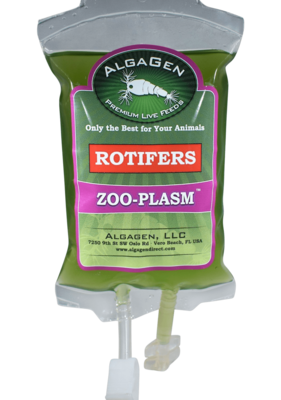
Zoo-Plasm™ Rotifers arrives as an already-established, actively reproducing culture, which sidesteps the early establishment period where population numbers are most vulnerable to collapse. Maintaining that population from day one comes down to consistent phytoplankton feeding, since a rotifer culture's reproductive output tracks food availability almost directly.
Understanding this lifespan also directly informs how often you should be harvesting from a culture for feeding purposes. Since individual rotifers only live one to two weeks and reproduce every one to two days under good conditions, a healthy culture can typically sustain regular harvesting of a portion of its population without collapsing, as long as feeding and water quality keep pace with what is being removed. Harvesting too aggressively, faster than the population can replace itself through reproduction, is one of the more common mistakes that leads to a culture crash.
Gut loading timing connects directly back to this lifespan discussion in a way that matters for anyone feeding rotifers to fish or coral. Rotifers hold nutritional value from their last meal for roughly four hours before that value begins to decline. This means the practical feeding value of a rotifer is not just about whether it is alive, but about when it last consumed phytoplankton relative to when you are offering it to your fish, larvae, or filter feeders.
Population crashes, when they happen, are usually explainable once you understand normal lifespan and reproduction patterns. A sudden die-off that seems to come from nowhere is often actually the result of a stressor, whether starvation, poor water quality, or overcrowding, compressing the natural one to two week lifespan down to just a few days across the entire population simultaneously. Recognizing early warning signs, like slowing movement or reduced numbers visible under magnification, gives you a chance to correct the underlying issue before a full crash occurs.
Species variation adds another layer of nuance worth understanding, since not every rotifer commonly used in the aquarium trade follows an identical lifespan pattern. Smaller species tend toward shorter individual lifespans paired with faster reproduction, making them well suited to feeding tiny-mouthed larvae that need a constant, quickly renewing supply. Larger species generally live somewhat longer as individuals but reproduce at a more moderate pace, which can make them a better fit for situations where consistent, predictable harvesting matters more than rapid population turnover.
Observing your culture directly under magnification gives you information that general lifespan averages cannot fully capture. A healthy culture shows a mix of life stages at any given moment, from newly hatched juveniles to mature, actively reproducing females, rather than a population skewed heavily toward one age group. A culture that appears uniformly small or uniformly sluggish under the microscope is often signaling an issue with feeding or water quality well before a visible crash occurs, giving you a window to intervene while there is still time to correct course.
Storage conditions between feedings also influence how much of a rotifer's natural lifespan you actually get to use productively. Refrigeration slows rotifer metabolism significantly, extending the practical window before a batch needs to be used or refreshed, though it does not stop the underlying aging process entirely. Keeping a portion of your culture refrigerated as backup, while maintaining an active, room-temperature culture for daily feeding and reproduction, gives you flexibility without demanding constant harvesting from a single actively growing population.
Rotifer lifespan is short by design, and that is actually part of what makes rotifer cultures so useful as a live food source. A population built around rapid reproduction and short individual lifespans can scale quickly to meet feeding demand, provided the culture receives consistent food, stable temperature, and reasonable water quality. Understanding that rhythm, rather than treating rotifers as a static supply, is what actually keeps a culture productive over the long run.
Frequently Asked Questions
How long does an individual rotifer typically live?
Most commonly cultured rotifer species live between one and two weeks under good conditions, with lifespan shortening in warmer water due to faster metabolism.
How often do rotifers reproduce?
Mature female rotifers typically produce new offspring every one to two days under favorable conditions, allowing populations to replace themselves continuously.
What causes a rotifer culture to crash suddenly?
Starvation, poor water quality, and overcrowding are the most common causes, often compressing individual lifespans and reproduction rates across the entire population at once.
Does water temperature affect how long rotifers live?
Yes. Warmer temperatures speed up metabolism and reproduction but shorten individual lifespan, while cooler temperatures slow both processes down.
Related Reading
Complete Guide to Rotifer Culture Kits
Discover What Are Rotifers
Zooplankton vs Phytoplankton: Reef Food Explained


Recent post