
Ask ten reef keepers how many hours of light their tank runs, and you will likely get ten different answers, each defended with total confidence. Photoperiod, the total number of hours a reef tank's lighting stays on each day, is one of those settings that everyone has an opinion about but few people actually explain clearly. Get it wrong in either direction, and the consequences show up gradually, which is exactly why so many tanks run the wrong photoperiod for months before anyone notices.
Too little light and corals struggle to photosynthesize enough to support their zooxanthellae population, leading to slow growth and dull coloration. Too much light, or a photoperiod that runs too long, and you invite exactly the kind of nuisance algae bloom that turns a beautiful reef tank into a maintenance headache. The right photoperiod sits in a fairly narrow band, and understanding why that band exists makes the whole decision much less mysterious.
Most established reef tanks run somewhere between eight and ten hours of total light per day. This is not an arbitrary number. It roughly mirrors the daylight hours corals experience on natural reefs near the equator, where day length stays relatively consistent year round. Corals evolved their zooxanthellae relationship around that rhythm, and while captive systems can tolerate some variation, staying close to that natural window keeps both coral health and algae growth in a manageable balance.
| Tank Stage | Recommended Photoperiod | Notes |
|---|---|---|
| New or newly cycled tank | 4 to 6 hours | Prevents early algae outbreaks before the tank stabilizes |
| Established SPS or mixed reef | 8 to 10 hours | Matches natural equatorial daylight patterns |
| LPS-dominant tank | 8 to 9 hours | LPS often prefers slightly less intense total exposure |
| Algae-prone tank | 6 to 7 hours | Temporarily reduced until nutrient levels stabilize |
Ramping is just as important as the total hour count. A photoperiod split into a gradual sunrise and sunset, rather than lights snapping on and off at full intensity, better mimics the natural transition corals evolved with and reduces the shock that sudden lighting changes can cause. Most modern reef lighting controllers allow this kind of ramping, typically building to peak intensity over the middle two to four hours of the photoperiod before tapering back down.
Peak intensity timing matters as much as the ramp itself. Corals do not need or benefit from maximum light output for the entire photoperiod. Concentrating peak intensity into a shorter window in the middle of the lighting cycle, while running lower intensity during the ramp up and down periods, gives corals a period of strong photosynthetic activity without extending the total high-intensity exposure longer than necessary.
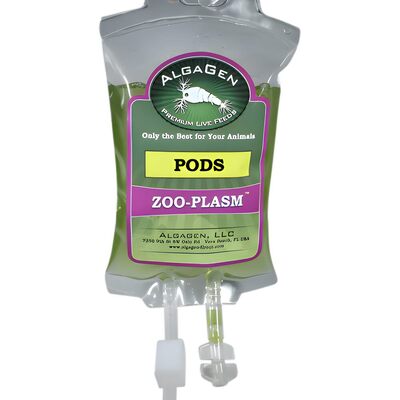
The dawn and dusk periods of a well-structured photoperiod are also a natural opportunity for feeding, since low light triggers more natural feeding behavior in many reef inhabitants than the middle of a bright midday period does. Zoo-Plasm™ PODS works particularly well timed to these low-light windows, and its Easy Feed Packaging option can be set to drip feed during dawn or dusk hours specifically, mirroring the natural feeding rhythm that reef inhabitants would experience on an actual reef.
Photoperiod also plays a direct role in nuisance algae control, which is often the real reason someone starts questioning their lighting schedule in the first place. Algae, like coral, needs light to grow, and a photoperiod that runs longer than necessary gives algae extra hours each day to outcompete the corals and beneficial organisms you actually want thriving. If a tank is dealing with a persistent algae problem, temporarily reducing photoperiod by an hour or two, combined with addressing the underlying nutrient levels, is often more effective than any algae treatment product on the market.
New tank owners sometimes make the mistake of running a full eight to ten hour photoperiod from day one, assuming more light means faster coral growth. In a newly cycled tank, nutrient levels are often unstable and the biological filtration is not yet mature enough to keep pace with algae growth triggered by extended light exposure. Starting with a shorter, four to six hour photoperiod and gradually extending it over the first month gives the tank time to stabilize before facing full light exposure.
Consistency matters more than precision here. A tank running a steady nine hour photoperiod every day will generally outperform a tank that fluctuates between six and eleven hours depending on the week, even if nine hours is not the theoretically perfect number for that specific system. Corals, like most living systems, respond better to predictable rhythms than to occasional optimization.
A timer or lighting controller removes most of the guesswork and, more importantly, removes the human error that tends to creep into manually managed photoperiods. It is easy to forget to turn lights off one night, or to leave them on an extra hour while distracted, and those small inconsistencies add up over weeks into a photoperiod that drifts well past what was originally intended. A programmed schedule holds the line automatically, which matters more for algae control than most people initially assume.
Watching how your specific corals respond over the first few weeks of a new photoperiod tells you more than any general guideline can. Polyp extension, coloration, and growth rate all shift in response to lighting changes, usually within one to two weeks. A coral that looks stressed, pale, or retracted after a photoperiod increase is signaling that the change happened too quickly, not that the target hour count itself was wrong. Small adjustments, given time to show their effect before making another change, lead to a more stable outcome than frequent large swings based on impatience.
There is no single universal photoperiod number that fits every tank, but there is a reliable process for finding the right one. Start conservative, extend gradually, watch how your corals and algae levels respond, and settle into a consistent daily rhythm once you find a range that keeps both healthy. That process, more than any specific hour count, is what actually determines whether your photoperiod is working for your reef.
Frequently Asked Questions
How many hours of light should a reef tank run per day?
Most established reef tanks run between eight and ten hours of total light per day, mirroring natural equatorial daylight patterns that corals evolved with.
Can too much light cause algae problems?
Yes. Extending photoperiod beyond what corals need gives nuisance algae extra hours each day to outcompete corals, often making photoperiod reduction more effective than algae treatments alone.
Should a new reef tank run a full photoperiod immediately?
No. New tanks benefit from a shorter four to six hour photoperiod initially, gradually extended over the first month as biological filtration matures.
Is ramping lighting gradually better than switching it on and off?
Yes. Gradual sunrise and sunset ramping better mimics natural lighting transitions and reduces stress compared to lights switching on or off at full intensity.
Related Reading
Reef Tank Lighting Spectrum, PAR, and Schedule
Understanding Zooxanthellae Algae and Its Benefits
Copepod Life Cycle From Nauplii to Adults


Recent post