
The phrase self-sustaining aquarium gets thrown around a lot, and it usually implies something that does not exist. No fish tank runs itself with zero input, ever, no matter how well it is built. What people actually mean, and what is genuinely achievable, is a tank where the biological systems handle most of the heavy lifting, leaving you with far less manual maintenance than a typical setup requires. That distinction matters, because chasing a fully closed loop leads to disappointment, while building toward a well-balanced biological system leads to a tank that is genuinely easier to keep.
Understanding what self-sustaining actually means starts with recognizing that a healthy aquarium is not one system. It is several overlapping systems working together, each handling a different part of the waste and nutrient cycle. When people say a tank feels effortless, what they are really describing is a setup where these systems are established well enough that they compensate for each other automatically.
The nitrogen cycle is the foundation everyone hears about, and for good reason. Beneficial bacteria colonies convert toxic ammonia from fish waste into nitrite, then into far less harmful nitrate. This process happens continuously once established, and it is the single most important biological system in any tank, self-sustaining or not. Without a mature bacterial colony, nothing else in this list matters, since ammonia and nitrite spikes will stress or kill livestock long before other systems get a chance to help.
| Building Block | Role in the Ecosystem | How to Establish It |
|---|---|---|
| Beneficial bacteria | Converts ammonia and nitrite into safer nitrate | Fully cycle the tank before adding livestock |
| Live phytoplankton base | Absorbs excess nutrients, feeds the food web | Dose regularly to support zooplankton populations |
| Copepods and microfauna | Consume detritus, provide natural fish food | Seed a refugium or display with a live culture |
| Live plants or macroalgae | Absorbs nitrate and phosphate directly | Plant heavily relative to bioload |
Sitting just above the bacterial layer is the phytoplankton base, and this is the part most beginner tanks skip entirely. Phytoplankton is the true bottom of the aquatic food web. It absorbs dissolved nutrients directly from the water, and it feeds the zooplankton, copepods, and filter feeders that occupy the next level up. A tank without any phytoplankton input is missing an entire trophic layer, which means more of the nutrient load falls on bacteria and manual water changes instead of being distributed across a functioning food web.
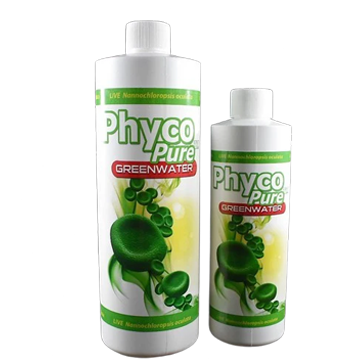
PhycoPure™ Greenwater fills this role directly. It is a live culture of a single-celled green microalga, dosed into the water column where it feeds rotifers, copepods, amphipods, corals, and filter feeders while simultaneously helping buffer the water against excess nutrients. Establishing a regular phytoplankton dosing routine is one of the most overlooked steps toward a genuinely lower-maintenance tank, since it strengthens every level of the food web sitting above it.
Copepods and other microfauna sit at the next level, and they are doing constant work that most tank owners never directly witness. Living in the substrate, on rockwork, and in refugiums, these tiny crustaceans graze on detritus, uneaten food, and algae film, converting it into their own biomass, which then becomes a food source for fish. This closes a small but meaningful loop. Waste becomes food, food becomes fish nutrition, and less waste is left to accumulate and require manual removal.
Live plants or macroalgae round out the picture for tanks that can support them. Unlike bacteria, which convert nitrogen compounds into progressively less harmful forms, plants actually remove nitrate and phosphate from the system entirely by incorporating them into their own growth. A heavily planted freshwater tank, or a saltwater system running a macroalgae refugium, exports nutrients in a way that bacteria alone cannot match.
None of these systems function well in isolation. A tank with excellent bacterial colonization but no phytoplankton or microfauna still relies heavily on manual water changes to manage nitrate, since bacteria only converts nitrogen compounds rather than removing them from the system. A tank with copepods but no phytoplankton base eventually sees that copepod population decline, since they have nothing consistent to eat. The systems reinforce each other, and skipping any one of them puts more pressure on the ones that remain.
Time is the ingredient most new tank owners underestimate. None of these biological systems establish overnight. Bacterial colonies typically take four to six weeks to fully mature during cycling. A copepod population needs a month or more of stable conditions before it reaches a size that meaningfully impacts detritus levels. Plants and macroalgae take even longer to develop the root systems and biomass needed for significant nutrient export. A tank that feels effortless after a year of running is not lucky. It is the result of biological systems that were given the time they needed to establish before being asked to carry the workload.
Overstocking is the fastest way to undo all of this progress, and it is a mistake even experienced hobbyists make once a tank starts looking healthy and understocked. Every one of these biological systems has a capacity limit. Bacteria can only process so much ammonia, phytoplankton can only absorb so many nutrients, and copepods can only consume so much detritus before their population is outpaced by the waste being produced. Adding livestock gradually, and pausing to let each addition settle into the existing biological balance, keeps these systems from becoming overwhelmed.
The honest version of self-sustaining is not a tank that needs nothing from you. It is a tank where beneficial bacteria, a phytoplankton base, a working population of copepods or microfauna, and where possible, live plants or macroalgae, are all established and reinforcing each other. Build those layers deliberately, give them time to mature, and the manual workload that remains becomes genuinely light. That is what people actually mean when they say a tank runs itself, even though something is always quietly working underneath the surface to make that possible.
Frequently Asked Questions
Can a fish tank truly run with zero maintenance?
No. Even the most balanced tanks still need periodic water changes, feeding, and monitoring. Self-sustaining refers to reduced manual workload, not zero involvement.
How long does it take to build a self-sustaining ecosystem?
Most tanks need three to six months for bacteria, phytoplankton, and microfauna populations to fully establish and start meaningfully reducing manual maintenance.
Do I need a refugium to have a self-sustaining tank?
Not strictly, but a refugium makes it much easier to grow macroalgae and copepod populations without livestock predation, which speeds up the entire process.
What is the most commonly skipped step in building this kind of ecosystem?
Phytoplankton dosing. Many tanks establish bacteria and even a cleanup crew but skip the phytoplankton base that actually feeds that cleanup crew long term.
Related Reading
How to Build a Self-Sustaining Aquarium System
The Role of Beneficial Bacteria in Aquariums
Copepods for Refugium Setup Guide


Recent post